Monday, October 22, 2018

Intro Into Theories On Teaching Young Children Letter Recognition


     If you have been following my blog you know we work on learning about the alphabet. There are differing opinions and theories on how to teach letter recognition correctly. Personally, I think there is no real wrong way to introduce it to little ones. The important thing is introducing it.
   
      I thought I would take a minute to share how I plan on helping my three yr old (his third birtbday is Thursday) with letter recognition. There are lots of teachers who believe that teaching the alphabet in order of the abc song is outdated, and maybe if you are really pushing early reading it is, For the first time through introducing my child to the alphabet I see nothing wrong with going through the order they are most likely already very familiar with. The traditional order. For the following times after I plan on re-introducing it to him phonetically instead of the traditional order.

     Marie Montessori was one of the first learning theorists who believed teaching the alphabet phonetically is more beneficial to the children as it helps them learn how to make simple words with them easier. There are other theories out there that prefer teaching the letters of the child's name first, then vowels, then consonants. Some theories believe we should teach all lowercase letters before introducing uppercase letters. There are still other theories out there that completely ignore teaching letters in the week altogether as they prefer letters that go with whatever subject theme they are working on that week. I would not say any of these ways are wrong. Just depends on what you feel more comfortable with.

Here are a couple of the more popular orders teachers will use to introduce letter recognition. There are so many other ideas for order of teaching the alphabet, but I like these two the best.


and this 

Thursday, October 18, 2018

Serving God Through Serving Others

   This week I thought I would introduce the idea of vocation to my child. As a Catholic I find it incredibly important to make sure my child knows how vital it is to pray to God to know what the best path in life is for hin. Keep close to God and He will lead you to the best path. In the Catholic faith there are four big groups of vocations that we have. A vocation to the priesthood, or to the religious life as a nun/sister/monk, the married life, and the sacred single life. What I care about the most as my child gets older is that he keeps God and getting into Heaven as his main focus when figuring out where his vocation should lead him.

      Our occupation as we get older is also a vocation. How we spread God's love through our work is the most beautiful way to make an occupation nore of a vocation. We learned a lot about community service workers and how we still serve God through helping our community. There are so many occupations to choose from and lots of activities to use to help children understand more about them.
     We also learned about the very important letter "Ii" and the number 4.


Monday: Intro of Uppercase "I"/Priests/Custodians
Books: My i Soundbox by Jane Belk Moore
Custodian by Debbie L. Yanuck
We Go to Mass by George Brundage
My First Dictionary "Ii" words only

Songs:Ten Little Indians
The Barney Clean-up Song

Activities:
Intro Uppercase I. Go over the "Ii" words in the picture dictionary
Color the "I" coloring page

Talk about Native American Indians snd explain how we are part of the blackfoot Indian tribe. Make a teepee tent inside and use pots and pans as the closest thing I had to native american drums. Play with large beads to make native american necklaces. Play with corn kernals and sunflower seeds and explain how Native Americans would grind up the seeds to make flour to cook with.

Intro idea of custodians and their importance to the community around us. Have him help me clean the windows like a custodian would do.
Intro the the importance of priests. Explain how just like custodians keep buildings clean and beautiful priests help keep our souls clean and beautiful. How important and special they are because only priests can bring Jesus to us every week at Mass. How only boys can grow up to be a priests and that is ok because God has other special things that only girls can grow up to do.
Play pretend Mass together.


Tuesday: Intro Number 4/Nuns/Firefighters
Books:One Big Building by Michael Dahl
Fireman Small by Wong Herbert
My First Dictionary "Ii" words only

Songs: 4 Little Firefighters (To the tune of itsy bitsy spider)
Four little firefighters sleeping in their beds.
Ding wemt the bell and down the pole they slid. 
They raced to the fire and put out all the flames
Then the four little firefighters went back to bed again.

Do You Know the Ice Cream Man? ( Tune of Do You Know the Muffin Man?)
Do you know the ice cream man, the ice cream man, the ice cream man?
Do you know the ice cream man you likes to sing with me?
Yes, he likes the letter I, the letter I, the letter I.
Yes, he likes the letter I and likes to sing with me

Activities:
Review "Ii" words in the picture dictionary of your choice

Introduce the number 4
Do the Number 4 coloring page

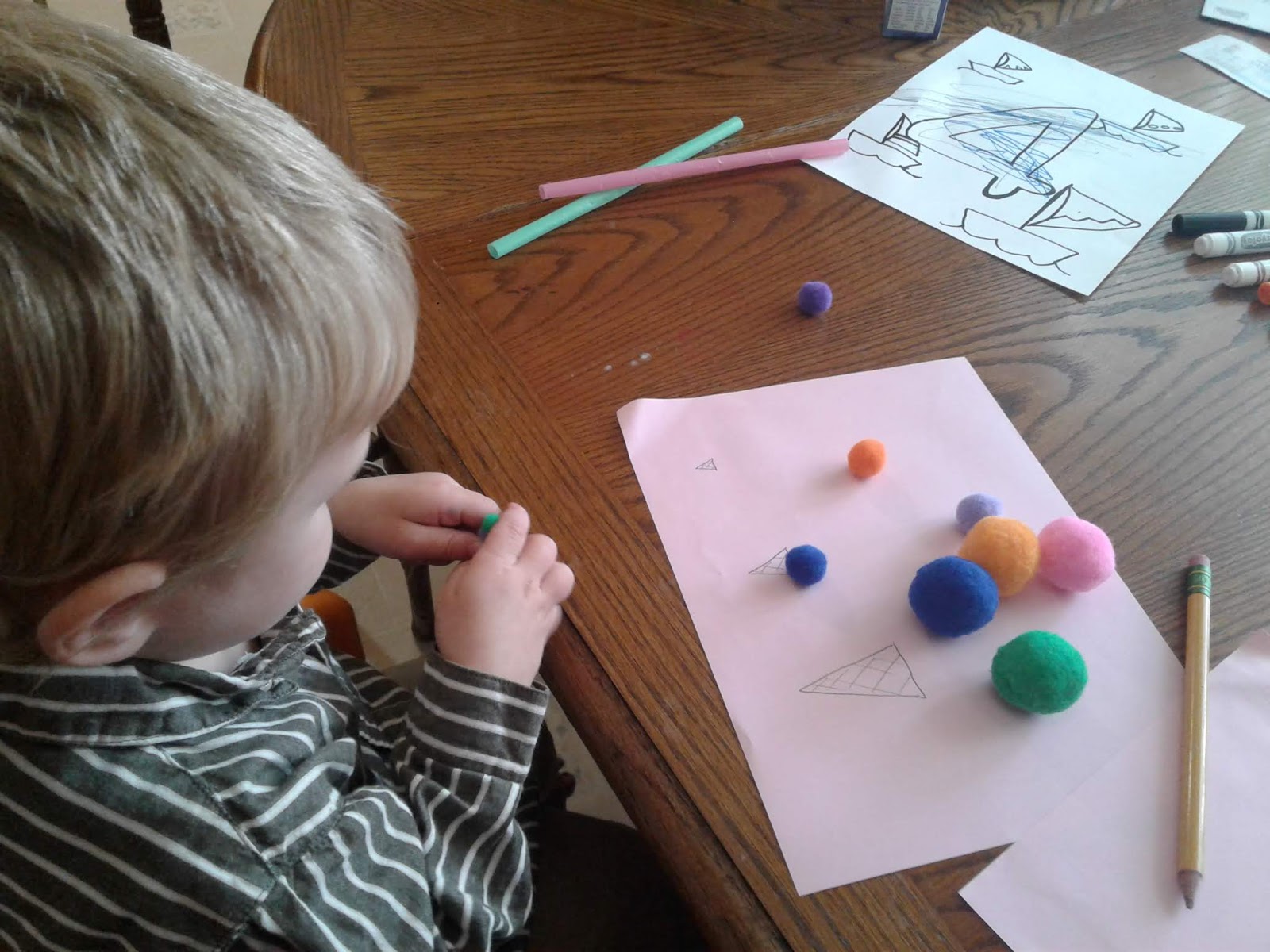
Use pom poms and take 4 of each size, or 4 of each color out. Draw ice cream cones on a paper...different sized ones of you want to focus on sizes, or seperate colors if you want to focus on colors. Then help the child seperate the pompoms in whichever group you decide before matching them to the right cones to make pom pom ice cream cones. After words let the child play around with the pom poms for sensory play. My child wanted to watch the pom poms go down our little ball track.

Intro the vocation of Nuns (I figure at his age it is easier to explain nuns for both sister and nuns and not mention monks just yet). Review what we learned about priests the day before and then explain how priests are always boys and nuns are only girls. How nuns marry Jesus and spend their time spreading God's love through prayer and acts of service. Taking care of the sick in hospitals or teaching in schools, or spending lots of time in prayer.

Play with our little saint peg dolls that Anthony's Papaw (my dad) handpainted for him and show which saints were priests and which ones were nuns.

Intro firefighters. Play with fire truck and firefighter helmets.


Wednesday:Lowercase "i"/Marriage/Food Service Workers 
Books: Insect Detector by Anita Holmes
Food Service Workers by Debbie L. Yanuck
My first dictionary "Ii" words only

Songs: Inch Worm by Kenny Loggins
The Itsy Bitsy Spider

Activities:
Review the Ii words in the picture dictionary
Intro lowercase i/i coloring page

Intro insects. Use play bugs and insectd in the dry rice sensory bin. Use what we learned about indects from the insect book to figure out which of the bugs are insects and which ones are creepy crawlers.

Intro the vocation of Marriage. Read the adam and eve story in the children's Bible to explain how God created man and woman to be together. Talk about how his momma and daddy are married because God showed us that is where He wanted us and we are now a family.

Intro food service workers. Play restaraunt and take turns being waiter/waitress. Have the child help set the table at dinner like food service workers do.


Thursday: Practice Tracing and Cutting/Sacred Single Life/ Garbage Man
Books:Ice Is Nice by Bonnie Worth
Trashy Town by Andrea Zimmerman and David Clemesha
My First Dictionary

Songs: A Big Green Iguana (tune of If You're Happy and You Know It)
Oh I wish I was a big green iguana
Oh I'd itch and I'd scratch
And I'd find a green leafy patch
Oh I wish I was a big green iguana

Garbage Truck, Garbage Truck rhyme
Garbage truck garbage truck one, two, thtee
Garbage truck garbage truck loud as can be
Dump all the garbage and smash it all down
Fill the truck before you leave this town

Activities:
Review "Ii" words from the dictionary

Practice tracing lines and work with cutting skills

Ice painting craft: freeze a block of ice then let the child paint it. Keep it out so the child can watch as it melts throughout the day

Make marshmallow igloos: use peanut butter or icing to keep the pieces together

Play garbage man toss. Watch how fast your child can get pieces of crumpled up paper into the trash can.

Put the crumpled up paper in different places around the room and use a dump truck to drive around pick up the trash.

Intro sacred single life. Talk about how not everyone will get married or be a priest or nun. Instead they will do other things but still spread God's love to the people around them.
       (Racing around to pick up the "trash")


Friday: Review "Ii" Vocab/Carpenters/Meteorologist
Books: What do Illustrators Do? by Eileen Christelow
Carpenters by Debbie Yanuck 
Meteorologist by Saundra J. Christian
My First Dictionary

Songs: Letter I Song (tune of John Jacob Jimgleheimer Schmidt)
Ichardo I has an itchy iguana
He has an igloo too
The words that start with i
The people leap up high
Words like ichardo's itchy iguana
i, i, i, i, i, i, i, i.

What Will the Weather Be Today?  Poem

What will the weather be today?
What will the meteorologist say?
Hot or cold? Wet or dry?
Clear or cloudy? Look up at the sky.

Activities:
Review Ii words in the dictionary and Ii vocab coloring page

Instrument day. Play with all the instruments, piano, play guitar, play drums...

Playdough ice cream cone fun

Practice playing with the iron (unplugged ofcourse) and iron board

Intro carpenters and St. Joseph.
Play with tool set and work on the tool puzzle we have.

Intro meteorologist and play weather man


There are so many occupations you can choose to focus on. Each have an important purpose need different personalities and special abilities to fill. What other occupations can you think of to help your child learn about? What activities could you add? Let me know please.




Wednesday, October 17, 2018

The Six Stages of Play


      I touched base on a previous post about dramatic play and the importance of giving kids free reign with their imaginations. Imagination is such an important thing to try and keep alive for as long as possible. Life will eventually try to break people from using our imaginations as much, and that is so sad to me. It is one reason I found working with young children so important and freeing. I am able to continue using my inagination while helping children use theirs. Imagination is what will help us continue making ideas into reality. The very first steps of sttengthening our children's imaginations is through ample time of playing, both socially, and independenly. There are six stages of play kids go through in the early stages of life. I thought I would share them with you here.


     The first stage begins at birth until about 3 months old (preemies tend to stay longer in this stage, but that is not something that will always be the case). It is called unoccupied play. They movements that they make with their bodies when they are awake and content are purposeful for them. Even that young they are using those brain muscles as well as full body muscles to figure out what cause and effect. Oh this is what happens if i move this. They are still experimenting cause and effect with their little bodies and kearning about their world.

The second stage is called solitary play. They go through this stage from about 3 months until they turn two. In this stage they are very into themselves and uninterested in anyone or anything else, but what they are doing at that moment. They are experimenting and collecting and storing their own data in their brains during this play stage. Socializing is not important to them during play except from sa caregiver when they need help with figuring a new toy out.

     The third stage is the onlooker stage. This last during age 2. They become more aware and intrigued by what others are doing, but not enough to join in. They are still happy playing on their own without interacting with other kids, but are beginning to see the fun in playing with other kids near their age.

     The fourth stage is called parallel play. It begins at 2+ yrs. During this stage childrendo not mind playing near one another, but there is no interaction yet between the other children. There is no connection of activities either. They are still happy doing their own thing.

     The fifth stage of play is called associative play stage. It can begin at about 3-4 yrs old. During this stage children begin enjoying doing activities in the same area, but still is not interactive with one another yet. They are happy coloring at the same table together, or building with blocks, but are not interested in sharing ideas yet.

     The sixth stage is cooperative play. This begins around age 4.  This is when you see children begin working together to play games or build blocks, or put puzzles together. It is the age where socializing becomes more important to the child.


     Are there other things you notice about these stages that I missed? If so please comment and share.

I

Monday, October 15, 2018

Intro to Jean Paiget's Stages of Cognitive Development Theory


     Last week I chose to break down Erikson's stages of development. This week I decided to talk a little about Jean Piaget's stages of development. There are four different development stages, and in each stage there are things the child goes through to move on to the next stage.

     Before explaining the stages I think it is importan to explain the term "schema" as it is a huge part of his theory.  Paiget believed that children collect data which is then turned into "schemas." A schema is the word he chose to use for objects the child first comes into contact with to learn about the world around him. A schema is then built on as more of the objects come into contact with the child for the child to build-up his/her own mental database. The schemas are then always changing as more information is learned.

     There are four phases a person goes through to understand each new schema. This photo may help explain this concept better than I may be able to.


  Now that I covered schemas I will now post the four stages of cognitive development Paiget believes we all go through.


Friday, October 12, 2018

Adventures In Potty Training: Take One

      Since going into the early childhood education field my age of expertise is also the age that deals with lots and lots of potty training. I have helped countless numbers of kids learn to use the potty. I have prided myself on knowing all there is to know about being a potty training expert. Enough to know that my son has not shown any interest whatsoever in the potty. He will sometimes put his corduroy bear on in to try, but other than that not interested...or so I thought.
      This week I was looking forward to a very chill week off from introducing any new comcepts to my kid. No lesson plans, just going with the flow. So you can imagine my complete surprise when my kid wakes up Monday morning asking to wear big boy underwear. I had already bought some to be ready for this moment, but with his lack of interest in anything with the potty you can imagine how shocked I was for this as well as hesitant. Big boy underwear was put on after he happily sat on the big boy potty and tried, unsuccessfully, to go potty. Day 1 came and went with lots of unsuccessful attempts at making it in the potty and lots of "accidents." I made big deal when he tried because he never wanted to do this before and downplayed his accidents. Day 2 was rougher to where he woke up begging for big boy underwear, but was more hesitant to sit on the big boy potty at all. Then the rest of the week was him terrified to go near the potty when he actually needed to go. Between his obvious fear and lack of care whether he was wet or dry, and my bad back issues I finally decided the stress was not worth it. He obviously is getting closer to wanting to use the potty, but not quite there, and you know that is ok with me. Potty training should not be filled with tears of fear and trying to hold onto me for dear life to avoid sitting on the potty.
    I also should add because his request of wanting to try out big boy underwear that night after he was in bed I actually became very emotional. There were legit tears while my husband was like, "Why are you crying about ditching diapers?" Honestly I think it was because I also was not mentally prepared for him to make that next step because it came out of no where. I did not cry when he moved from his crib to his big boy bed. I did not cry when we took the rocking chair out of his room. I did not cry when after 3 weeks my kid still refused his naps. Yet, him showing signs of readiness to ditch his diapers did me in. Of course the next morning I started my period, so I know half of that was pms...
     So his first time trying out the potty was not "successful" in the sense that we are moving out of diapers, cause we went back to them. It was successful though because he is aware of the potty. Of not being afraid of sitting on it. Sometimes it is best to go back and wait a month or two. From my years of potty training other's kids I know that it is not odd for a kid to be almost 4 before being fully potty trained. My kid has time. He will get there. It will be on his time though, and not mine.
     Anyone have any helpful potty training tops to share? Please comment ways that helped your child.


Wednesday, October 10, 2018

Importance of Slowing Down and Living In the Moment

     In the midst of lesson planning and setting up educational activities it is easy to be more in my head doing a mental checklist instead of fully enjoying what my child is actually experiencing. It is important for me to remember he is still young. He is not a baby, but still not fully independent. It is important to me that I also relish these days as much as possible, even though some days are harder than others. I need to remember to let him play and explore as there is only so much time left for him to be really free of the book lrarning style that comes in elementary school. There is no rush right now for what he must learn by a certain time, it really should be more fun than anything else. Some days it is ok to forget what was planned and chill. Giving downtime like that will only help my kid be more relaxed and ready to learn something new, and that is a big deal.


Monday, October 8, 2018

Intro to Erik Erikson's Psychsocial Development Theory


     Eric Ericson is one of the bigger education/behavioral theorists we needed to learn about while working on our early childhood degrees. He is also one of the ones that we loved to hate if only because of one huge paper we had to write about un an introspective way about how we perceived our life was during each of the eight stages of erikson's theory. Remembering under the age of two is basically impossible, yet we had to figure out enough to fill several pages of that first stage. If we messed up that particular paper grade basically we knew we screwed up our grade for the class enough to fail.

     Erikson believed every person goes through eight stages of life. In each stage there is a conflict and depending on our resolution of that conflict would affect us in the next phase for worse or for better.

Because of not having as much time to personally break these down for you, I decided to share this graph that I hope explains the eight phases to you.


Sorry For My Absence